This Winter logic word puzzle activity is a way for kids to use logical thinking and pattern matching paired with spatial recognition and spelling.
In this word-fill puzzle, children compare word lengths, use shared letters, and explain why an option fits or cannot fit. The goal is to place the supplied winter words into the connected grid. No computer or previous coding experience is needed.

This post contains affiliate links. As an Amazon Associate, Our Family Code earns from qualifying purchases. Please see our Disclosure Policy for more details.
In this activity
- Computational Thinking Concepts
- Logical Reasoning
- How to Solve the Winter Logic Word Puzzle
- What Is Included in the Winter Word Puzzle?
- Prepare the Page and Agree on the Rules
- Start with a Worked Length Clue
- Use a Repeatable Solving Routine
- Debug a Word That Does Not Fit
- Adapt the Puzzle for Home or Classroom
- Connect the Puzzle to Computational Thinking
- Winter Logic Word Puzzle FAQ
Computational Thinking Concepts
Computational thinking is a new way of problem-solving that involves thinking about a problem in a way that can be solved by using computing tools like logic, decomposition, abstractions, algorithms, patterns, data collection and analysis, and simulation or modeling.
Computational thinking can be used to solve problems in almost all areas of our lives and helps kids develop some pretty great life skills that can apply to a variety of situations. A computational thinker approaches problems by:
- Experimenting and playing to solve a problem that might have more than one possible solution
- Working together with others to reach a common goal
- Persevering when faced with a difficult problem
- Finding and fixing errors in complex problems
- Designing and making solutions for open-ended problems
- Understanding their own strengths and weaknesses
Logical Reasoning
Logical reasoning is the ability to analyze and make predictions about things or explaining why something is the way that it is.
Logic puzzles are a great way to use to emphasize the concept of logical reasoning by explaining why a word cannot fit in a certain space.
Due to the number of letters in each word, kids can speak to why each word goes in each space, which helps them to solve the puzzle.
How to Solve the Winter Logic Word Puzzle
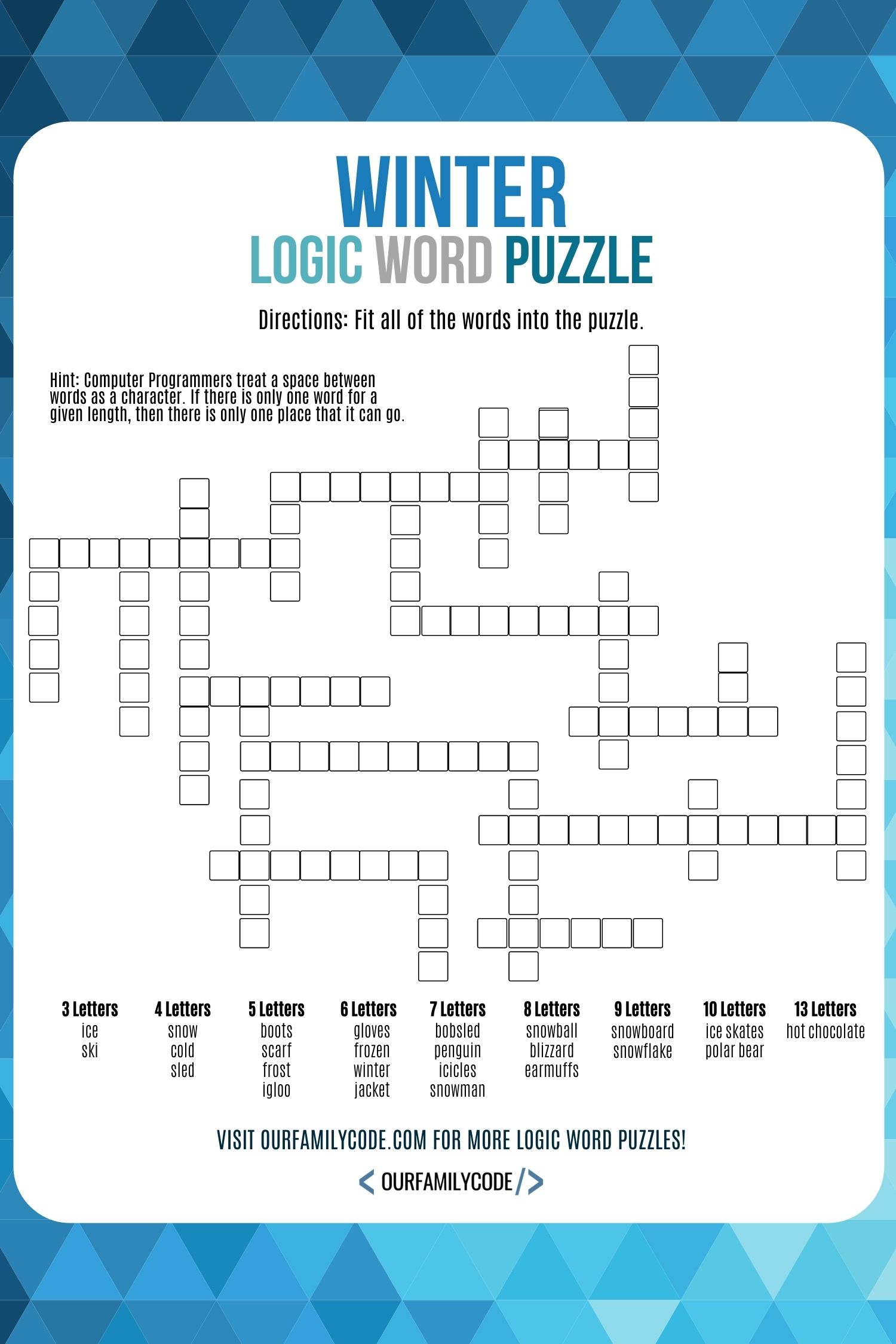
Begin by comparing the word bank with the grid. A length with only one listed word is a useful starting clue when there is exactly one matching slot. Then use crossing letters to narrow the remaining choices. Word length alone does not choose between two words in the same length group.
Once you know some letters in the grid, then you can count how many letters long each space is (how many blocks) and compare it to the words remaining using the letters filled in from the previous word.
Go slowly and think through your puzzle. Use a pencil! Some of the clues will not be helpful right away. Keep working through the list of words and go back.
What Is Included in the Winter Word Puzzle?
The printable contains a connected word-fill grid and a winter word bank grouped by length. Unlike a traditional crossword, it does not ask children to answer numbered definition clues. They use the supplied words, the number of boxes, and the letters where entries cross to work out the arrangement. Some words fit the same length, so the crossings become important as the puzzle develops.
The word bank includes short words such as ice and ski, longer words such as snowflake and snowboard, and phrases such as ice skates, polar bear, and hot chocolate. Read the words together before starting. A child who does not know a word’s meaning can still compare letters, but a quick vocabulary conversation makes the winter theme more meaningful.
Prepare the Page and Agree on the Rules
Print the puzzle and gather a pencil and eraser. A dry-erase sleeve is optional if you want to reuse the sheet. Keep the word bank visible while introducing the task. Before writing, ask children to point to a horizontal slot, a vertical slot, and a square where two entries cross. The crossing square belongs to both entries, so the letters written there must agree.
Use the words exactly as listed and cross each one off only after placing it. Write horizontal entries left to right and vertical entries top to bottom. A blank square reserved for the space in a phrase still counts as a position. Review this convention before beginning, because many other word puzzles remove spaces between words. This page deliberately uses a different rule.
Start with a Worked Length Clue
Look at the thirteen-character group in the word bank. It contains one phrase: hot chocolate. Count it together: HOT has three letters, the space counts as one position, and CHOCOLATE has nine letters. Three plus one plus nine makes thirteen. Locate the long thirteen-box slot in the lower part of the grid and check its length before entering the phrase.
Write HOT, leave the fourth box blank for the space, and continue with CHOCOLATE. Now look for other entries crossing that slot. Each shared letter adds information. An intersecting word must have the correct length and the correct letter in the crossing position. Do not assume that finding one shared letter proves the entire word fits; check every known crossing before committing to it.
For comparison, ice and ski both belong to the three-letter group. Counting three boxes cannot tell you which one belongs in a particular short slot. Once a crossing letter is available, compare its position in both candidates. A word may contain the right letter but still fail if that letter occurs in a different position from the shared square.
Use a Repeatable Solving Routine
Choose an unfinished slot and count its positions. Find the corresponding length group in the word bank. Ignore words already used, then compare each remaining candidate against every letter already in the slot. If exactly one candidate matches all the available information, enter it lightly in pencil and cross it off the list. If several candidates still match, leave the slot for now.
After placing a word, revisit the entries that cross it. A word that was ambiguous earlier may now have enough information. Continue moving between the grid and the list rather than trying to solve the word bank from top to bottom. This back-and-forth process is the main reasoning work: each placement changes what you know about several other spaces.
Encourage children to explain a choice using evidence. “It is the right length” is a start; “It has seven positions and the third letter matches this crossing” is a more complete explanation. If they cannot yet choose between two candidates, naming both possibilities is useful progress. Waiting for another clue is a deliberate solving decision, not a failure to finish that section.
Debug a Word That Does Not Fit
If a new word conflicts with a letter already written, pause before erasing the entire grid. Check the spelling against the word bank, recount the slot, and check whether the entry is a phrase with a space. Then examine the earlier word at the crossing. Either placement could be responsible for the conflict; the newest answer is not automatically the incorrect one.
Use small pencil notes to mark uncertain candidates, keeping them separate from confirmed entries. If a tentative placement later creates a contradiction, erase that placement and test the alternative against the remaining crossings. When a child fixes an error, ask what clue helped. That explanation connects debugging with the evidence on the page rather than with trial and error alone.
Adapt the Puzzle for Home or Classroom
For a beginner, an adult can help count the boxes and read the word bank while the child chooses between candidates. Work on a small section together and stop when attention fades. Letter tiles can help a child arrange a possible word beside the page before writing it. Use a separate gap or a paper marker to represent a space when building a two-word phrase.
For partner work, one child can be the grid checker and the other the word-bank checker. The first counts positions and reports known letters; the second proposes candidates and explains why they match. Switch roles after a few entries. Each partner should still be able to see the full page so the activity remains a shared reasoning task rather than a guessing game.
For an extension, invite children to create a small word-fill puzzle of their own using familiar winter words. Start with two crossing words, draw the grid, and write a word bank that includes their lengths. Trade puzzles and test whether the instructions are clear. Check every crossing before adding more words; a smaller puzzle that works is more useful than a large grid with incompatible entries.
Connect the Puzzle to Computational Thinking
The solving routine is an algorithm: count, compare, check crossings, place a word, and repeat. Breaking the grid into individual slots is decomposition. Keeping track of unused words is a simple data-management task. Finding a conflict and revising an earlier choice is debugging. These are connections to ways of thinking used in computing, even though the worksheet is a word puzzle rather than a computer program.
Finish by asking children to describe one decision they could justify and one place where they changed their mind. The completed grid is useful, but their explanation shows how they used the constraints. For more puzzles with the same format, explore our free logic word puzzle collection and review each page’s space-counting convention before beginning.
For a hands-on twist, use Bananagrams or Scrabble to build your words with letter tiles!
We like to use dry erase pocket sleeves for all of our worksheets so that we can reuse them for all of these kiddos I have running around this house.
Don’t forget the space between words!
This printable treats a space as one character and gives it its own box. For example, “ice skates” uses ten boxes: three for ICE, one blank space, and six for SKATES. “Polar bear” also uses ten, while “hot chocolate” uses thirteen. Keep the space box blank, but include it when checking the length and crossing positions.
If you like this Winter logic word puzzle, then you should visit our logic word puzzle hub to find more great logical thinking puzzles!
Winter Logic Word Puzzle FAQ
Is this a crossword or a word search?
It is a word-fill puzzle. Place the supplied winter words into the connected grid using their lengths and crossing letters. There are no numbered definition clues.
Do spaces count in this winter puzzle?
Yes. This printable gives a space its own box. Ice skates and polar bear each use ten positions, while hot chocolate uses thirteen.
What should we do if two words have the same length?
Compare the known crossing letters and their positions. If more than one candidate still fits, work on another entry and return when you have another clue.
DON’T FORGET TO PIN THIS POST TO SAVE THIS ACTIVITY FOR LATER!

Logic Word Puzzles
Did you enjoy this logic word puzzle? We have a ton of logic word puzzles for kids to work on vocabulary and logical reasoning skills!


Meet Toni, the Maker Mom behind Our Family Code

Hey there, I’m Toni! I’m a software engineer and Maker Mom that finds my joy in unleashing my children’s curiosity by exploring STEAM concepts with my fantastic five!
When I’m not chasing toddlers or raising tweens, you can find me tearing things up and putting them back together over here at Our Family Code.
I am the owner and content creator of multiple educational websites designed to increase access to STEAM & STEM education with a focus on teaching computer science and coding to kids of all ages!