We love superheroes at our house, and this superhero logic word puzzle gives that interest a paper-and-pencil challenge. Kids fit a word bank into a crossing grid by checking word lengths and matching letters, rather than answering trivia about particular movies.
Use the free two-page printable for a quiet activity, a superhero theme, or a shared reasoning lesson. A pencil and eraser are enough to start, and the answer key on page two can help you check a difficult crossing without giving away the whole puzzle.

Table of Contents
This post contains affiliate links. As an Amazon Associate, Our Family Code earns from qualifying purchases. Please see our Disclosure Policy for more details.
What Kind of Puzzle Is This?
This is a word-fill puzzle with a crossword-style grid. The word bank supplies the entries, and the connected rows and columns provide constraints. It is different from a word search, where the words are already hidden among other letters, and from a clue crossword, where you must work out the answers from definitions.
Each word has to satisfy more than one condition. It must fit the number of boxes, agree with letters already placed at crossings, and still be available in the word bank. A word that meets only the length condition is a possible candidate, not automatically the answer.
Treat each listed entry as a word to use once. Cross it off lightly after placing it, and uncross it if you later erase that placement. Keeping the word bank synchronized with the grid is part of the reasoning task; otherwise, a word may appear to be missing simply because it was crossed off too early.
How to Solve the Superhero Logic Word Puzzle
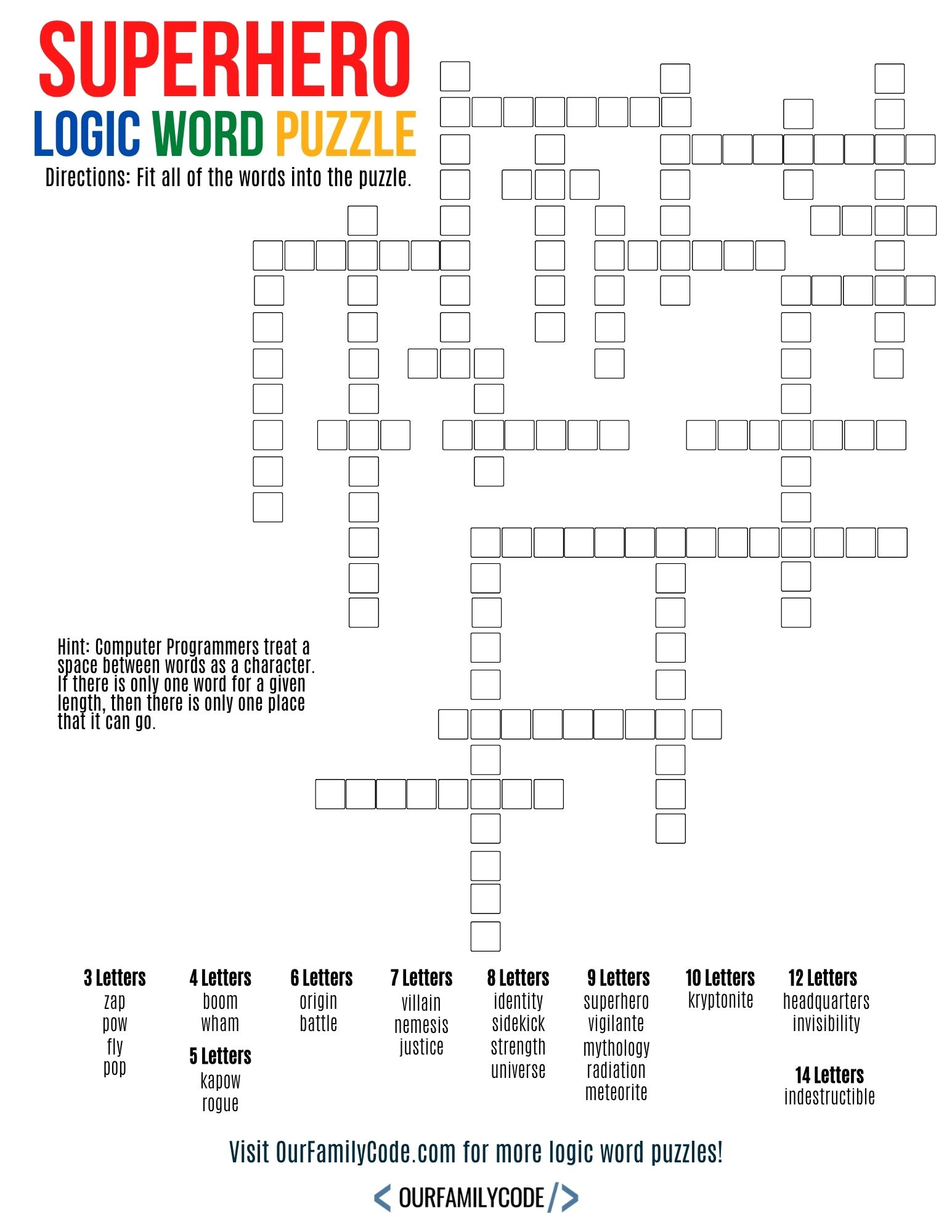
Begin by looking over the complete sheet. Notice that the words are grouped by length, from short sound-effect words such as ZAP to the long word INDESTRUCTIBLE. Choose a long, distinctive slot or a group with only one available word as a starting point, and count the boxes carefully.
The word INDESTRUCTIBLE has 14 letters. Count the long horizontal run one box at a time and check it against that length. If it is the only 14-box slot and INDESTRUCTIBLE is the only 14-letter word available, that matching pair provides a useful first placement. Use the actual grid and remaining list to check both sides of the match.
Write one letter in each box. When a word crosses another slot, its letter becomes information for the crossing word. Now count that second slot and compare its known letter positions with the words of the appropriate length. Eliminate candidates that disagree at even one crossing.
Continue with the slot that gives you the most information. You do not have to solve the grid from top to bottom. A short word with two confirmed crossing letters may be easier than a long word with none. If several words still fit, leave a small candidate note on scrap paper and work on another part of the grid.
Practice Comparing Candidates Before Writing
Here is a small example using real words from this printable. It demonstrates the comparison method; it is not a claim that these exact crossing positions occur in a particular slot of the worksheet.
| Information about a 3-box slot | Candidates that still fit |
|---|---|
| Only the length is known | ZAP, POW, FLY, POP |
| The first letter is P | POW or POP |
| The first letter is P and the last is W | POW |
| The first letter is P and the last is P | POP |
Ask children to explain an elimination: “FLY cannot fit because it starts with F, but this crossing needs P.” That explanation gives you more information about their reasoning than simply asking them to name the answer. Check that the crossing letter itself comes from a secure placement before relying on it.
The same idea works with longer words. KRYPTONITE has ten letters, while HEADQUARTERS and INVISIBILITY each have twelve. A twelve-box slot rules out KRYPTONITE immediately, but it does not choose between the two twelve-letter entries until more information is available.
Check Your Work Without Revealing Everything
When you get stuck, recount the boxes and compare the spelling letter by letter. Long words are easy to shift by one square. Check whether you accidentally skipped a letter, wrote two letters in one box, or counted a nearby square that does not belong to that continuous run.
Next, trace back to the most recent uncertain placement. A confident-looking crossing can be wrong if it came from an earlier guess. Erase only the doubtful entry at first, keep the confirmed information, and test the candidates again. This is debugging: use the result to locate a mistake, then revise the instructions or placement.
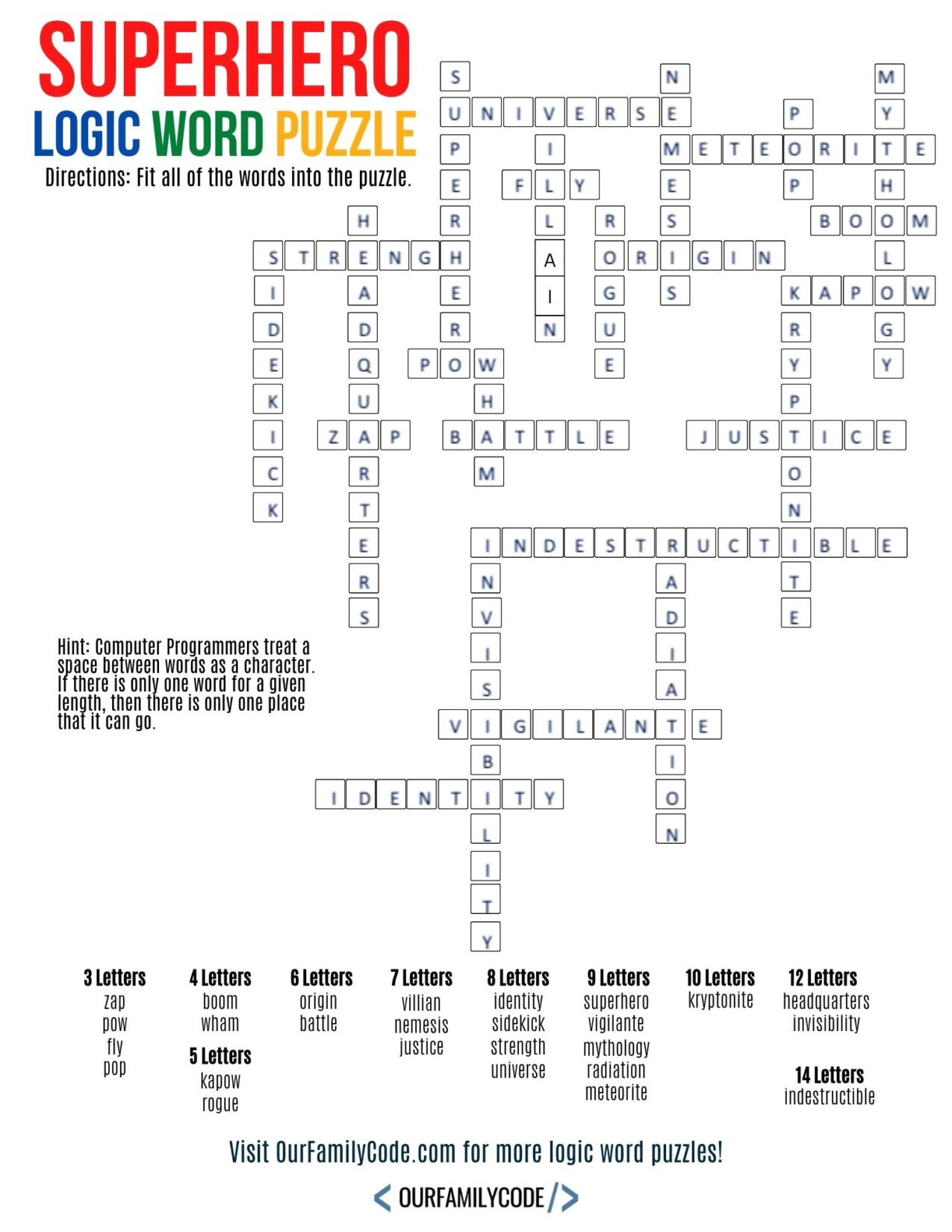
Use page two for one small check when needed. An adult can reveal a single letter or confirm one word while covering the rest of the answer key. Compare the remaining entries and crossings yourself before looking at the complete solution.
Connect the Puzzle with Computational Thinking
Breaking the whole grid into individual word slots is decomposition. Grouping candidates by length and matching crossing letters is a way to apply constraints. Keeping a record of placed and unused words helps organize the information needed for the next decision.
You can express a candidate check as a yes-or-no question: “Does this word have the right length AND match every known crossing?” Both conditions need to be true before it remains a candidate. That connects naturally with Boolean reasoning, while the worksheet itself remains a word puzzle rather than a computer program.
Ask children to say their procedure aloud: count the slot, choose the right length group, compare known letters, place a justified word, and update the list. Different solvers may choose different starting slots. A clear explanation and consistent checks matter more than everyone following one identical order.
Adapt the Activity for Different Learners
For newer readers, read the word bank together and discuss unfamiliar vocabulary before solving. Let an adult handle writing while the child counts boxes, identifies matching letters, or chooses between two candidates. Work on a small part of the puzzle and return later if the full grid feels too demanding.
For more independent readers, ask them to keep a candidate list and justify a placement using both length and a crossing. They can also describe an error they corrected and explain what evidence changed their mind. Keep a guessed word visibly different from a confirmed placement until it has been checked.
For a partner activity, one person can count slots while the other checks the word bank. Switch jobs regularly so both learners practice reading and reasoning. Give each pair its own copy or scratch sheet; a crowded shared grid can hide useful thinking behind hurried handwriting.
Optional Materials and Vocabulary Extensions
For a hands-on twist, use Bananagrams or Scrabble tiles to build a word before copying it into the grid. Paper letter squares work too. Tiles help make spelling visible, but you still need to check the word against its crossings.
We like dry erase pocket sleeves when several children will reuse a worksheet. Follow the sleeve and marker instructions, test that the writing erases, and keep the separate answer key nearby for checking. A pencil copy is just as useful for a single session.
After solving, choose a few words and write a short superhero story. Discuss the difference between a hero, sidekick, and nemesis, or ask children to explain an unfamiliar word in their own language. Use standard spellings in the story, including VILLAIN, and separate imaginative superhero ideas from real-world science.
Download the Superhero Logic Word Puzzle
The PDF has two pages: the blank puzzle and its answer key. Print page one for the solver and keep page two separate if you want the solution to stay hidden.
Check the print preview before printing. The grid and word bank should both fit on the page, with the small letters readable. Use a comfortable paper size and printer scaling setting rather than enlarging the puzzle so much that part of the grid disappears beyond the printable area.
Find More Logic Word Puzzles
Visit our free logic word puzzle collection or try the Community Helpers puzzle and Barnyard logic puzzle. For a different paper coding activity, explore bitmap coding and artwork.

Superhero Logic Word Puzzle FAQ
Is this superhero puzzle a word search?
No. It is a word-fill puzzle. Choose words from the bank and fit them into the empty crossing grid by comparing lengths and matching letters. You do not search for words already hidden in a field of letters.
Does the free printable include an answer key?
Yes. The two-page PDF includes the blank puzzle on page one and the completed grid on page two. Print only page one for learners, and keep the answer page separate. When someone gets stuck, reveal one crossing letter or confirm one entry before showing the full solution.
Meet Toni, the Maker Mom behind Our Family Code

Hey there, I’m Toni! I’m a software engineer and Maker Mom that finds my joy in unleashing my children’s curiosity by exploring STEAM concepts with my fantastic five!
When I’m not chasing toddlers or raising tweens, you can find me tearing things up and putting them back together over here at Our Family Code.
I am the owner and content creator of multiple educational websites designed to increase access to STEAM & STEM education with a focus on teaching computer science and coding to kids of all ages!