

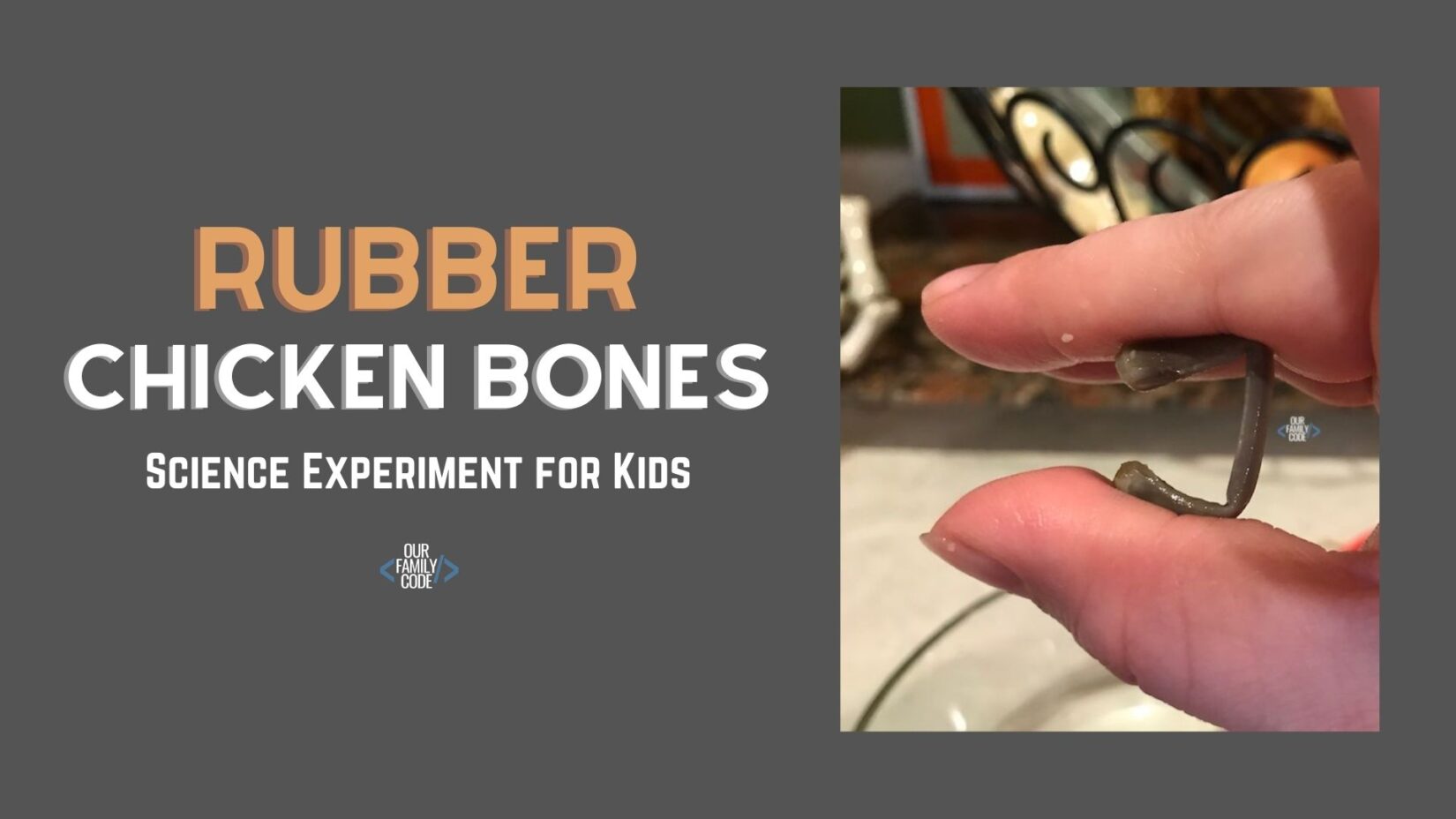
Can you turn a hard chicken bone into something that bends almost like rubber?
With a little vinegar and a few days of patience, you can.
In this rubber chicken bone experiment, kids investigate what gives bones their strength by soaking a cleaned chicken bone in vinegar and observing how its properties change over time.
It’s simple, slightly creepy, and perfect for Halloween science.
Looking for more spooky experiments? This activity is part of our collection of 31+ Halloween STEM Activities for Kids, including candy chemistry, apple mummies, erupting pumpkins, static electricity zombies, and more.
This post contains affiliate links. As an Amazon Associate, Our Family Code earns from qualifying purchases. Please see our Disclosure Policy for more details.
Why Are Bones Hard but Still Flexible?
Bones may look like solid rock, but they are actually complex biological materials.
Bone contains a mineral component, largely calcium phosphate in the form of hydroxyapatite, embedded within a protein-rich matrix that contains a large amount of collagen. The mineral helps make bone hard and strong, while collagen adds flexibility and resilience.
That combination matters.
A material made only from hard mineral would be much more brittle. A material made only from flexible protein would bend too easily.
Bone gets useful mechanical properties from having both.
This experiment lets kids see what happens when we remove much of that mineral component.
What Does Vinegar Do to Chicken Bones?
Vinegar contains acetic acid.
When a chicken bone sits in vinegar, the acidic solution reacts with and gradually removes mineral from the bone.
This process is called demineralization.
As the mineral content decreases, the remaining collagen-rich structure becomes much easier to bend.
The bone has not literally turned into rubber.
It simply feels rubbery because much of the rigid mineral material that normally reinforces the collagen matrix has been removed.
Rubber Chicken Bone Experiment Supplies
You’ll need:
- Clean cooked chicken bones
- White vinegar
- Glass jar or sealable container
- Lid or plastic wrap
- Water
- Paper towels
- Tongs, optional
- Notebook or science journal
We used bones from a cooked rotisserie chicken, which makes this an easy experiment to do after dinner.
Choose bones that are fairly intact so you can compare their stiffness before and after soaking.
Safety Notes
Use cooked, cleaned chicken bones rather than raw chicken bones for this activity.
An adult should remove any remaining meat, cartilage, or tissue from the bones before the experiment begins.
Wash hands after handling the bones, and do not eat the bones or anything used in the experiment.
The vinegar-soaked bones are for observation only.
How to Make Rubber Chicken Bones
1. Clean the Chicken Bones
Remove as much meat, cartilage, skin, and other tissue as possible.
Rinse the bones thoroughly with water.
The cleaner the bone is, the easier it will be to observe changes during the experiment.
Pat the bones dry with a paper towel.

2. Test the Bone Before Soaking
Before adding vinegar, try gently bending the chicken bone.
Do not force it until it breaks.
Instead, observe how rigid it feels.
Ask kids:
Does the bone bend at all?
Does it feel hard or flexible?
What do you predict will happen after several days in vinegar?
Record those starting observations.
3. Make a Hypothesis
A hypothesis is a prediction you can test.
For example:
I think the chicken bone will become easier to bend after soaking in vinegar because the acid will remove some of the mineral that makes the bone rigid.
Kids can also predict how long they think the change will take.
Will the bone bend after one day? Three days? A full week?
4. Cover the Bone with Vinegar
Place the chicken bone in a glass jar or container.
Pour in enough white vinegar to completely cover the bone.
Seal the container loosely with a lid or cover it according to your setup.
Make sure the entire bone remains submerged.
5. Observe the Bone Each Day
Check the bone once a day.
You may notice bubbles forming in the liquid or changes to the surface of the bone.
Ask kids to observe:
- Color
- Texture
- Smell
- Flexibility
- Surface appearance
- Changes in the vinegar
Do not bend the bone aggressively every day, because repeated handling could damage it before the experiment is finished.
6. Replace the Vinegar if Needed
If the vinegar becomes cloudy or the experiment seems to slow down, replace it with fresh vinegar.
Fresh vinegar provides additional acid for the demineralization process. Make sure the bone remains completely covered.
7. Test the Bone After Several Days
After about 5–7 days, remove the bone and rinse it gently with water.
Try bending it again. How does it compare with the original bone?
Smaller bones may become noticeably flexible within a week. Larger or thicker bones can take longer.
In our original experiment, some of the larger bones needed about two weeks before they became dramatically bendable.

Rubber Chicken Bones After One Week
After several days in vinegar, the chicken bones should feel noticeably different.
The bone may still look fairly normal from the outside, but its mechanical properties have changed.
Try gently bending it from both ends. Does it flex more than it did on Day 1?
How far can it bend before you begin to feel resistance? Compare the result with your original prediction.

What Happens After Two Weeks?
If a larger bone still feels stiff after one week, return it to fresh vinegar and continue the experiment.
Our larger bones needed additional time. After about two weeks, they became dramatically more flexible and much closer to the “rubber bone” effect we were hoping to observe.

This is a useful reminder that sample size matters in experiments.
A small, thin bone and a large, thick bone may respond at very different rates even though they are exposed to the same vinegar.

The Science Behind the Rubber Chicken Bone Experiment
Bone is a composite material.
The hydroxyapatite reinforces the bone and contributes much of its hardness.
The collagen framework contributes flexibility and toughness. When the bone is soaked in vinegar, the acidic solution gradually demineralizes it.
As the rigid mineral component is removed, the softer collagen-rich matrix becomes much more noticeable.
That is why the bone becomes bendable rather than simply disappearing.

Why Doesn’t the Vinegar Dissolve the Entire Bone?
Because bone is not made entirely of mineral. The acid affects the mineral portion much more strongly than the collagen matrix.
Once enough mineral has been removed, the remaining structure is largely supported by flexible proteins.
That leftover collagen framework is what allows the demineralized bone to bend.
You can think of it a little like reinforced concrete.
The mineral and protein work together to create a material with properties neither component would have on its own.
Is the Bone Actually Rubber?
No. The phrase rubber chicken bone describes how the bone feels after demineralization.
It has not chemically transformed into rubber. The flexible material you are handling is still biological tissue, with much of the mineral component removed.
That distinction is worth discussing with kids because science experiments often produce results that look like one thing while actually involving a very different process.
Turn This Into a Controlled Science Experiment
Instead of soaking only one bone, try comparing several conditions.
For example:
- Bone in vinegar
- Bone in water
- Bone in no liquid
- Small bone in vinegar
- Large bone in vinegar
The bone in water can serve as a useful comparison.
If the water-soaked bone stays relatively rigid while the vinegar-soaked bone becomes flexible, kids have stronger evidence that the acidic environment caused the change.
Rubber Bone Experiment Variables
Independent Variable
The independent variable is the condition you intentionally change.
If you compare vinegar with water, the independent variable is the liquid used for soaking.
Dependent Variable
The dependent variable is what you observe or measure.
In this experiment, that could be:
- Bone flexibility
- Amount of bending
- Time required to become flexible
- Change in mass
Controlled Variables
Try to keep other conditions as consistent as possible.
That might include:
- Similar bone type
- Similar bone size
- Same amount of liquid
- Same container size
- Same temperature
- Same soaking time
Measure the Bone Before and After
Older kids can make the experiment more quantitative.
Measure the bone before soaking.
You could record:
- Mass
- Length
- Circumference
- Maximum safe bending distance
After the experiment, repeat those measurements.
Did the bone lose mass? Did its size change? Did its flexibility change even if its dimensions remained similar?
This gives kids another way to connect visible observations with measurable data.
Why Bone Size Changes the Experiment
A thicker bone contains more material for the vinegar to penetrate and demineralize.
That means smaller bones often appear to soften faster than larger ones.
In our experiment, the smaller bones became bendable first while the larger bones required more soaking time.
That creates another possible experiment:
Does bone thickness affect how quickly vinegar makes a chicken bone flexible?
Use several bone sizes and record how many days each takes to reach a similar level of flexibility.
Questions to Ask During the Experiment
Try asking:
- Why do you think the bone is hard before soaking?
- What do you predict vinegar will change?
- Why might a smaller bone soften faster?
- Why doesn’t the entire bone disappear?
- What evidence shows that the bone changed?
- How could we measure flexibility instead of only describing it?
- What would happen if we used water instead of vinegar?
- What variables should we keep the same?
Encourage kids to use observations from the experiment to support their answers.
What Kids Learn from the Rubber Chicken Bone Experiment
This simple activity connects chemistry and biology in a very visible way.
Kids investigate:
- Acids
- Mineralization
- Demineralization
- Bone structure
- Collagen
- Hydroxyapatite
- Experimental variables
- Scientific observation
- Comparing evidence
It also demonstrates an important idea in materials science:
The properties of a material depend on what it is made of and how those components work together.
Looking for More Easy STEM Activities?
If your kids like science experiments that use ordinary household materials, explore our 31 Days of Low-Prep STEM and STEAM Activities for Kids.
You’ll find simple science, technology, engineering, art, and math activities that are easy to set up without turning your kitchen into a supply warehouse.
Try More Halloween Science Experiments
Keep the creepy science going with our Apple Mummification Experiment, test acids with our Candy Chemistry Experiment, or make a pumpkin bubble with Mini Erupting Pumpkins.
You can also browse our complete collection of 31+ Halloween STEM Activities for Kids for more chemistry, physics, coding, engineering, math, and preschool activities.
You Might Also Like
Apple Mummification Experiment
Use apples to investigate drying, preservation, decomposition, and Ancient Egyptian mummification.

Try the Apple Mummification Experiment →
Candy Chemistry Experiment
Test leftover Halloween candy and observe acid-base reactions with baking soda.

Try the Candy Chemistry Experiment →
Sticky Spider Web Science
Investigate spider silk, proteins, and the materials science behind sticky spider webs.
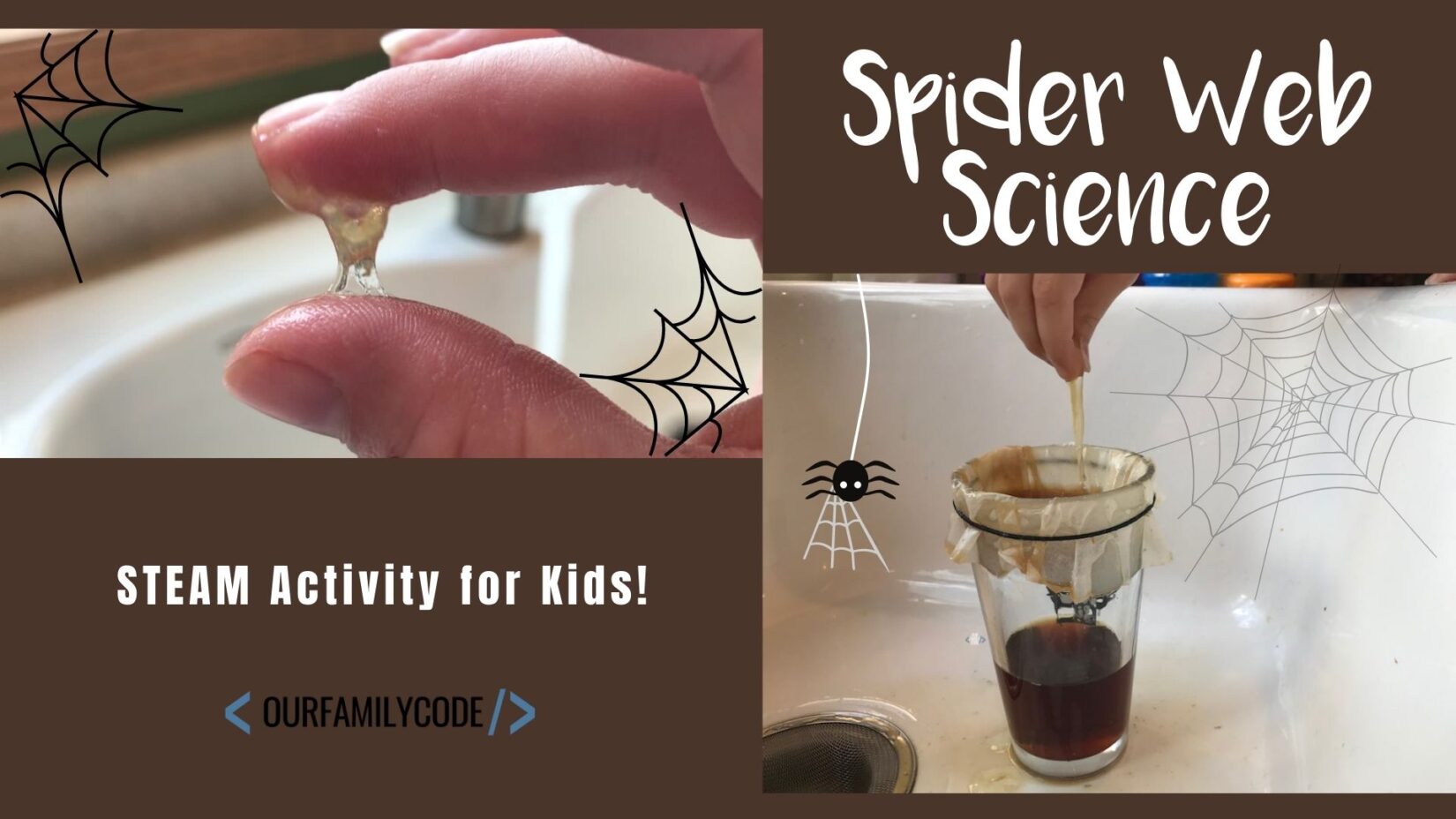
Try the Sticky Spider Web Science Activity →
A chicken bone turning bendable looks a little like Halloween magic.
The better explanation is chemistry.

Meet Toni, the Maker Mom behind Our Family Code

Hey there, I’m Toni! I’m a software engineer and Maker Mom that finds my joy in unleashing my children’s curiosity by exploring STEAM concepts with my fantastic five!
When I’m not chasing toddlers or raising tweens, you can find me tearing things up and putting them back together over here at Our Family Code.
I am the owner and content creator of multiple educational websites designed to increase access to STEAM & STEM education with a focus on teaching computer science and coding to kids of all ages!


