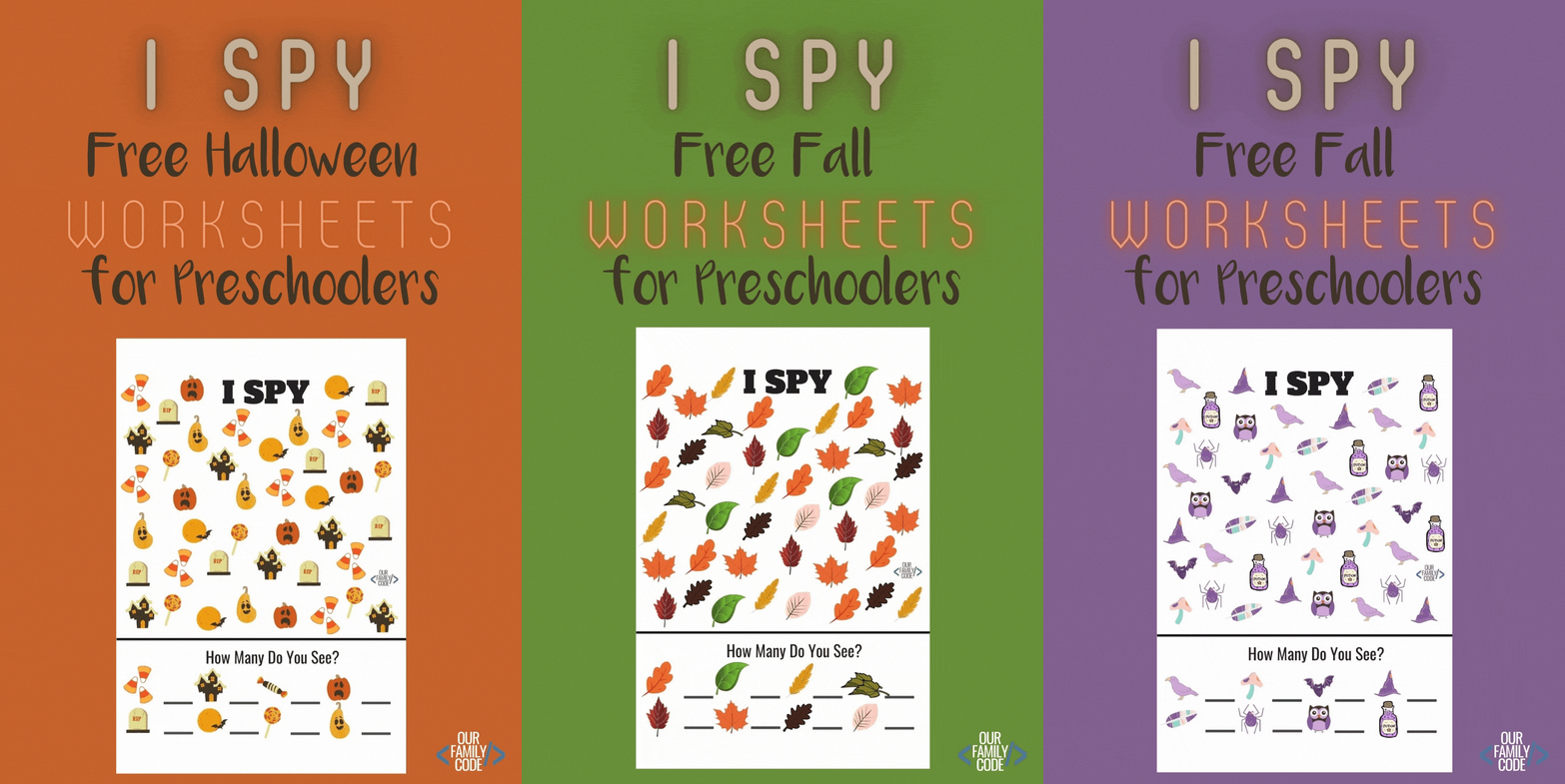
These free Fall I SPY worksheets for preschoolers turn seasonal pictures into a playful counting and visual-discrimination activity. Children search for leaves, witches, pumpkins, bats, and other fall or Halloween objects, then record how many of each picture they can find.
Use these Fall I Spy worksheets at home, in a preschool classroom, at a library program, or as a quiet activity during a Halloween party. Each worksheet builds early math skills without feeling like a formal lesson, and the downloads can be printed individually so you can choose the page that fits your theme.
Place the pages in dry-erase pockets if you want children to use them more than once. You can also pair the worksheets with our 31+ Halloween STEM activities for a full month of hands-on seasonal learning.

What Kids Learn with Fall I Spy Worksheets
An I Spy page asks children to scan a busy picture, locate one type of object, and keep track of what they have already counted. That simple routine combines several skills preschoolers need for early math, reading, and classroom learning.
Counting objects supports one-to-one correspondence, which means touching or identifying one object for each number word. Children also practice cardinality when they understand that the last number they say represents the total number of objects in the group.
Visual discrimination helps children notice the differences between pictures that share similar colors, shapes, or details. This is the same type of careful observation they will later use to distinguish letters, numbers, patterns, and common sight words.
Writing the total beside each picture adds number recognition and fine-motor practice. If a child is not ready to write numerals independently, let them trace a number, copy it from a number line, use a number card, or tell an adult what to record.
- Count objects using one-to-one correspondence.
- Recognize and write numerals.
- Compare groups using more, fewer, and the same.
- Sort pictures by color, shape, or category.
- Strengthen visual scanning and attention to detail.
- Practice using positional words such as above, below, beside, and between.
How to Use the I Spy Printables
Start by looking at the small picture clues below the black line. Name each object together before your child begins so you know that the vocabulary and images are familiar.
Choose one clue and search only for that object. Encourage the child to point to each match while saying the counting sequence aloud, then write the total next to the matching clue.
- Pick one object from the answer area.
- Scan the worksheet from left to right and top to bottom.
- Touch, circle, or cover each matching picture once.
- Count the complete group again to check the total.
- Record the number beside the picture clue.
- Repeat with the next object until the page is complete.
A systematic search pattern makes it easier to avoid skipping or counting an object twice. Model how to move across one row before starting the next row, much like tracking words across a page when reading.
Readers have also shared a great hands-on strategy: place small erasers, buttons, pom-poms, or other counters on top of the pictures. Physically covering each object gives children a concrete way to organize their counting and makes the activity easier to check.
Adapt the Activity for Different Learners
For toddlers or beginning counters, adapt the Fall I Spy worksheets by completing one object at a time and counting no more than a few matches before taking a break. An adult can write the answers while the child points, names, and counts.
For preschoolers who are ready for more independence, give them a dry-erase marker and ask them to circle each picture before recording the total. Invite them to explain how they know they found every match.
Older preschoolers and kindergarteners can compare totals, order the groups from least to greatest, or write simple equations. For example, they can combine two groups and solve a question such as “How many leaves and acorns are there altogether?”
Children who find busy pages visually overwhelming may benefit from a blank index card used as a guide. Cover most of the page and reveal one horizontal section at a time so the search area feels more manageable.
Fall Leaf I Spy Worksheet for Preschoolers
The fall leaf page works well for a nature, tree, or changing-seasons theme. Before starting, ask children to notice the colors and shapes they see, then compare the illustrated leaves with real specimens collected on a walk.
Extend the activity by sorting real leaves by color, size, edge, or shape. Our chalk pastel leaf rubbings and nature walk leaf activities make useful hands-on companions to this printable.

After the page is complete, ask which object appeared most often and which appeared least often. Children can build matching groups with counters or draw that many leaves on a separate sheet of paper.
Halloween Witch I Spy Preschool Worksheet
The purple witch worksheet adds playful Halloween pictures without relying on anything scary. It is a simple choice for a classroom center, preschool party, quiet-time basket, or activity table while older children work on a more advanced project.
Our family loves to fill October with decorations and Halloween STEAM activities. This page can serve as the math portion of a themed lesson before children move into a science experiment, building challenge, or art project.

Turn the worksheet into a listening game by describing an object without naming it. Give clues about its color, shape, or location and ask children to identify the picture, then let them create clues for someone else.
Vintage Halloween I Spy Worksheet
The vintage-style page has a different collection of seasonal pictures and gives children a fresh search challenge. Use it after the witch page to discuss which objects appear on both worksheets and which are unique to only one page.
This printable also works well during a family Halloween party. Pair it with cupcakes, a glow-in-the-dark candy hunt, a drive to see neighborhood decorations, or a round of Halloween Bingo.

When children finish, invite them to choose a favorite picture and draw a larger version. They can also make their own mini I Spy scene by drawing several repeated objects and challenging a family member to count them.
More Ways to Practice Preschool Math
Counting the pictures is only the beginning. Ask children to compare two groups using the words more, fewer, or equal, then encourage them to prove their answer by matching objects one-to-one with counters.
You can introduce simple graphing by writing the object names along the bottom of a sheet of paper and coloring one square for each match. The completed graph makes it easy to see which category has the greatest or smallest total.
Practice early addition by choosing two picture groups and combining their totals. If subtraction is appropriate, begin with the larger group and ask how many would remain if one or two objects disappeared.
Patterning is another easy extension. Choose two pictures from the page, draw an AB pattern, and ask the child what comes next; older children can try ABB, AAB, or ABC patterns with three different Halloween objects.
Printing and Reusing the Worksheets
Print the Fall I Spy worksheets at actual size or fit them to standard letter paper. Color printing makes the objects easiest to distinguish, but the activity can still be used in grayscale if children carefully compare shapes and details.
For repeated use, slide the page into a dry-erase pocket or laminate it. Test markers on a small corner first, wipe the page after each use, and store the worksheets flat with the counters or writing tools you plan to use.
If you are preparing a classroom center, print one copy for each child or place several protected copies at the table. Keep small counters in a shallow tray and avoid loose pieces with children who may still put objects in their mouths.
Use the Worksheets at Home or in a Classroom
At home, keep one worksheet with crayons or dry-erase markers in a quiet-time basket. The familiar format is useful during meal preparation, sibling homework time, travel, or any moment when a child wants an independent activity with a clear beginning and ending.
In a classroom, use the Fall I Spy worksheets in a math center with a small number line, counters, and pencils. Children can work alone, with a partner, or beside an adult who models the search-and-count routine before gradually reducing support.
Partners can take turns choosing an object, counting the matches, and checking one another’s totals. Encourage them to explain disagreements by recounting together instead of simply changing an answer.
The printables also make an easy observation activity for preschool teachers. Notice whether a child counts in a stable sequence, tracks objects without repeating them, recognizes the written numeral, and compares groups accurately; those observations can guide the next counting lesson.
Questions to Ask While Children Play
- Which picture did you find first?
- How did you make sure you counted each object only once?
- Which group has the most pictures? Which has the fewest?
- Are any two groups equal?
- What changes when you add one more object?
- Can you describe where an object is without pointing to it?
- What pattern can you make with two or three pictures?
Open-ended questions make the child’s thinking visible and give you a chance to model useful math language. Focus on the counting process instead of rushing to correct an answer; recounting and finding a mistake are valuable parts of learning.
Find More Free I Spy Worksheets
Continue the activity with our free Halloween worksheets for kids, Thanksgiving activity worksheets, or Christmas worksheets. Rotating seasonal pages keeps the search format familiar while giving children new pictures and vocabulary to explore.
You Might Also Like
Meet Toni, the Maker Mom behind Our Family Code

Hey there, I’m Toni! I’m a software engineer and Maker Mom that finds my joy in unleashing my children’s curiosity by exploring STEAM concepts with my fantastic five!
When I’m not chasing toddlers or raising tweens, you can find me tearing things up and putting them back together over here at Our Family Code.
I am the owner and content creator of multiple educational websites designed to increase access to STEAM & STEM education with a focus on teaching computer science and coding to kids of all ages!