

Have you ever wanted to make a bowl of zombie brains?
Not actual brains, obviously.
This brain slime recipe uses guar gum instead of glue to create a weird, clumpy, slippery gel that looks appropriately disgusting for Halloween.
The texture is different from traditional stretchy glue slime. It feels more like a thick gel or squishy ice-pack filling, which is exactly why it works so well as zombie brain slime for sensory bins, mystery-touch activities, and Halloween science.
Even better, there’s real polymer chemistry happening underneath all that grossness.
Looking for more spooky science? Find this activity and dozens more in our 31+ Halloween STEM Activities for Kids.

This post contains affiliate links. As an Amazon Associate, Our Family Code earns from qualifying purchases. Please see our Disclosure Policy for more details.
What Is Brain Slime?
Most homemade slime recipes use washable PVA glue.
This one doesn’t.
Instead, our no-glue slime starts with guar gum, a plant-derived polysaccharide that acts as a thickener and contains long polymer chains.
When guar gum is mixed with water, those long molecules help create a thick solution.
Adding a borax solution introduces borate species that can form connections between parts of the guar gum polymer chains. Researchers use borate to cross-link guar gum into gel networks for the same underlying reason: the borate interacts with hydroxyl groups on the guar polymer.
Those connections change the way the material flows and give us our strange zombie-brain texture.
Is This the Same as Regular Slime?
Not quite.
Traditional school-glue slime is usually made with polyvinyl alcohol-based glue and a borate-containing activator. According to the American Chemical Society, Borate ions create links between polymer chains, changing a pourable polymer solution into a much more elastic material.
Guar gum is a different polymer, so the finished texture is different too.
Our brain slime is:
- Less stretchy than glue slime
- More gel-like
- Clumpier
- Slippery rather than sticky
- Excellent for gross Halloween sensory play
If your goal is a classic stretchy slime, use one of our traditional slime recipes instead.
If your goal is something that looks like it came directly out of a zombie movie, keep going.

Brain Slime Supplies
You’ll need:
- ½ cup (120 mL) cold water
- 1 teaspoon (5 mL) guar gum
- 1/2 teaspoon (2.5 mL) borax
- 2 teaspoons (10 mL) hot tap water
- Red food coloring
- Two small cups
- Wooden craft sticks or spoons
- Measuring spoons
- Sealable bag or slime storage container
Guar gum is commonly sold as a baking thickener, especially for gluten-free cooking.
Safety Note
This slime is not edible.
An adult should measure and prepare the borax solution. Avoid getting borax or slime in the eyes or mouth, wash hands after play, and stop using it if skin becomes irritated.
Young children should use the slime only with direct adult supervision.
How to Make Zombie Brain Slime Without Glue
1. Add Cold Water to a Cup
Pour ½ cup of cold water into one of your cups.
Cold water is intentional here.
Guar gum hydrates differently depending on how it is dispersed and mixed. For this activity, we actually want the mixture to stay a little uneven and clumpy because that helps create the brain-like texture.
2. Add the Guar Gum
Sprinkle 1 teaspoon of guar gum into the cold water.
Stir with a wooden craft stick.
The mixture will begin thickening and may look cloudy or lumpy.
That’s fine.
We aren’t trying to create a perfectly smooth food-grade guar solution.
We’re making zombie brains.
3. Add Red Food Coloring
Add a few drops of red food coloring.
Stir until the color is distributed through the mixture.
Start with a small amount. You can always add another drop if your zombie needs a more dramatic brain situation.
For an even creepier look, experiment with a tiny amount of blue or purple mixed into the red.
4. Let the Guar Gum Hydrate
Allow the guar gum mixture to sit for about 5–10 minutes.
While it rests, prepare the activator.
The mixture may continue thickening as the guar gum interacts with the water.

Make the Borax Solution
An adult should complete this step.
In the second cup, combine:
½ teaspoon borax
with
2 teaspoons hot tap water
Stir until the borax is dissolved as completely as possible.
This solution will act as the cross-linking component in our brain slime.
Combine the Brain Slime Mixtures
Slowly add the borax solution to the guar gum mixture while stirring.
Don’t dump everything in and immediately walk away.
Watch what happens to the texture as the two mixtures combine.
The cloudy guar solution should begin turning into a much thicker, clumpier gel.
Keep stirring until the mixture develops the consistency you want.
Then congratulations.
You have made zombie brain slime.

Note: This brain slime only lasts for a few days in a sealed plastic bag! When you are done with the slime, throw the bag in the garbage.
The Science Behind Guar Gum Slime
Guar gum is a polysaccharide, which means it is made from long chains of sugar-based molecular units.
Those long chains make guar useful as a thickener.
When guar gum is mixed with water, its polymer chains interact with the surrounding water and dramatically increase the viscosity of the mixture.
But thickening alone is not what gives us the final gel.
Borax in water produces borate species that can interact with hydroxyl groups on guar gum chains and create cross-links between polymer molecules. That creates a three-dimensional network that behaves differently from the original guar solution.
Think of uncross-linked polymer chains like piles of long strings that can slide past each other.
Cross-linking creates connections between those strings.
Now they can’t move past one another as easily.
The result is a thicker, more elastic gel.
What Is a Polymer?
A polymer is a very large molecule made from repeating smaller chemical units.
Some polymers are synthetic.
Others occur naturally.
Guar gum is a natural polymer derived from the guar plant.
The word polymer comes from Greek roots meaning roughly many parts, which is a useful way to picture these long molecular chains.
Polymers are everywhere.
Examples include:
- DNA
- Cellulose
- Proteins
- Natural rubber
- Starch
- Many plastics
And, of course, plenty of slime.
What Is Cross-Linking?
Cross-linking happens when connections form between polymer chains.
Imagine several bowls of cooked spaghetti.
If every noodle can slide independently, the whole pile moves fairly easily.
Now imagine connecting many of those noodles together at different points.
The network becomes harder to pull apart and moves differently.
That isn’t a perfect molecular model, but it gives kids a useful visual for what happens when a cross-linking agent connects polymer chains.
In our brain slime, borate helps create those connections within the guar gum network.
Is Brain Slime a Solid or a Liquid?
This is where slime gets interesting.
Slime does not behave exactly like an ordinary liquid or an ordinary solid.
Many slime-type materials display non-Newtonian behavior, meaning their flow properties can change depending on how force is applied. The American Chemical Society describes slime as a non-Newtonian fluid whose viscosity and behavior change under mechanical stress.
Try interacting with the brain slime in different ways.
Slowly let it move through your fingers.
Then squeeze it.
Pull it.
Poke it.


Does it behave exactly the same way every time?
Why Does This Slime Feel Different from Glue Slime?
Because the polymer is different.
Classic homemade slime generally starts with polymers in PVA-based glue.
This recipe starts with guar gum.
The amount of polymer, water, borate, mixing, and temperature can all change the final texture.
That makes this a great opportunity to ask a bigger science question:
How do changes in ingredients affect the properties of a material?
Instead of treating the recipe as something kids simply follow, let them investigate it.
Turn Brain Slime into a Science Experiment
Make more than one small batch and change a single variable.
For example:
Change the Amount of Guar Gum
Try one batch with less guar gum and another with more.
Which is thicker?
Which flows faster?
Which looks the most like brains?
Change the Water Temperature
Compare guar gum added to cold water with guar gum added to warmer water.
Does the texture change?
Does one mixture become smoother?
Change the Activator Amount
With an adult controlling the borax solution, compare batches receiving different measured amounts.
Does additional cross-linking make the slime firmer?
Can too much activator make the texture less pleasant?
Only change one factor at a time if you want to make meaningful comparisons.
Brain Slime Experiment Variables
Independent Variable
The independent variable is the factor you intentionally change.
That could be:
- Guar gum amount
- Water temperature
- Activator amount
- Mixing time
Dependent Variable
The dependent variable is what you observe or measure.
For brain slime, you might investigate:
- How far it stretches
- How quickly it flows
- Firmness
- Thickness
- Clumpiness
Controlled Variables
Keep the other conditions as consistent as possible.
That might include:
- Water volume
- Cup size
- Food coloring amount
- Mixing time
- Resting time
Measure Your Slime
Older kids can make the investigation more quantitative.
Slime Stretch Test
Hold the slime and slowly pull it apart.
Measure how far it stretches before breaking.
Record the distance.
Slime Flow Test
Place the same amount of slime near the top of a tilted tray.
Measure how long it takes to travel a set distance.
Slime Squish Test
Place a measured amount of slime beneath a lightweight object.
Compare how much different recipes spread.
These aren’t perfect laboratory measurements, but they give kids a way to move from:
“This feels weird.”
to:
“How can we collect evidence about how weird it is?”
Make a Zombie Brain Sensory Bin
Once your slime is finished, turn it into Halloween sensory play.
Place the brain slime in a bowl or sensory container and add Halloween-themed objects.
You might include:
- Plastic eyeballs
- Toy bugs
- Plastic bones
- Small zombie figures
- Halloween rings
- Plastic spiders
Kids can search through the slime, sort objects, count what they find, or simply explore the texture.

Use Brain Slime for a Mystery Touch Game
This texture is also perfect for a classic Halloween mystery box.
Place the slime inside an opaque container where kids can reach in without seeing what is inside.
Tell them they’re touching zombie brains.
For younger kids, keep the game silly rather than genuinely frightening.
Then reveal what the “brains” actually are and talk about why the material feels the way it does.
How Long Does Brain Slime Last?
This guar gum slime is best treated as a short-term sensory material.
Store it in a sealed container or plastic bag between uses.
Our original batch lasted only a few days before we discarded it.
Because this recipe contains lots of water and is not formulated as a preserved commercial product, I would not try to keep it for weeks.
If the color, odor, or appearance changes, throw it away.
Do not dispose of large amounts down the drain.
Questions to Ask Kids About Brain Slime
Try asking:
- What changed when we added the borax solution?
- Why is guar gum called a polymer?
- What do you think cross-linking does?
- How is this slime different from glue slime?
- What happens when you squeeze it quickly?
- What happens when you let it flow slowly?
- Which ingredient would you change to make it thicker?
- How could we measure the slime instead of just describing it?
- What variable should we change next?
The goal isn’t simply to make slime.
It’s to get kids thinking about why the material behaves the way it does.
What Kids Learn from Zombie Brain Slime
This creepy Halloween sensory activity introduces kids to:
- Polymers
- Cross-linking
- Viscosity
- Material properties
- Mixtures
- Experimental variables
- Measurement
- Scientific observation
It also gives kids plenty of opportunities to make predictions, change a recipe, compare results, and explain what they observe.
That is a lot of science hiding inside a bowl of zombie brains.
Looking for More Slime Science?
If your kids want to compare this no-glue recipe with traditional slime, try our DIY Slime Kit and Saline Solution Slime Recipe.
That activity uses PVA glue and gives kids another way to explore polymers and slime activators.
Comparing two different slime recipes is actually a great experiment on its own.
How does changing the polymer change the material?
Try More Halloween STEM Activities
Keep the creepy science going with our Zombie Static Electricity Experiment, Candy Chemistry Experiment, or Sticky Spider Web Science Activity.
You can also find this brain slime and dozens of other projects in our collection of 31+ Halloween STEM Activities for Kids.
You Might Also Like
Raise a Zombie with Static Electricity
Use electric charge to make a paper zombie move without touching it.
Try the Zombie Static Electricity Experiment →
Candy Chemistry Experiment
Use leftover Halloween candy to investigate acids, bases, and carbon dioxide reactions.

Try the Candy Chemistry Experiment →
Sticky Spider Web Science
Explore spider silk, proteins, and the materials science behind sticky webs.
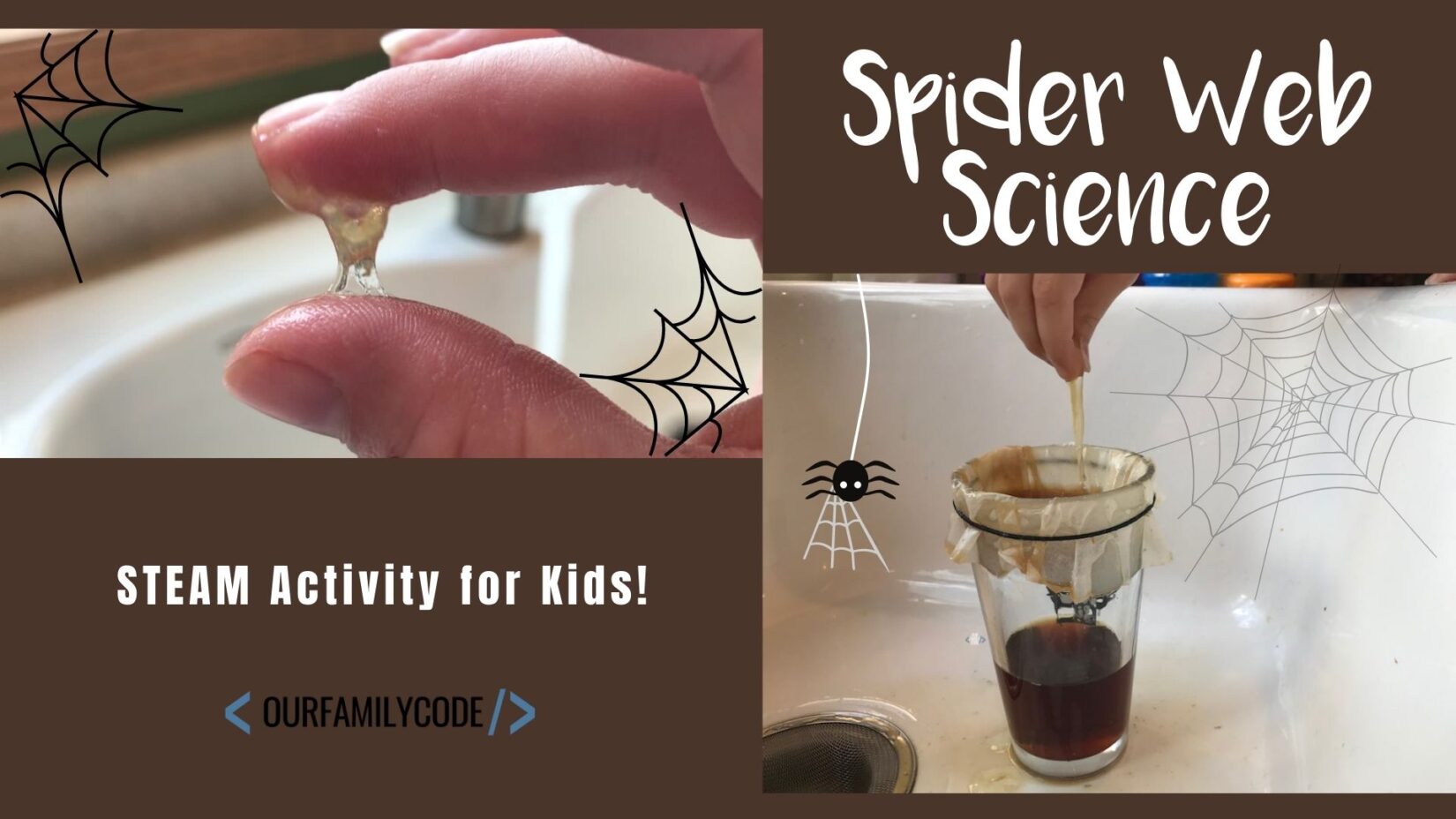
Try the Sticky Spider Web Science Activity →
It looks disgusting. It feels weird. That makes it pretty much perfect Halloween science.

Meet Toni, the Maker Mom behind Our Family Code

Hey there, I’m Toni! I’m a software engineer and Maker Mom that finds my joy in unleashing my children’s curiosity by exploring STEAM concepts with my fantastic five!
When I’m not chasing toddlers or raising tweens, you can find me tearing things up and putting them back together over here at Our Family Code.
I am the owner and content creator of multiple educational websites designed to increase access to STEAM & STEM education with a focus on teaching computer science and coding to kids of all ages!


