How many gifts would you receive if every earlier gift in “The 12 Days of Christmas” arrived again each day? This 12 Days of Christmas Pascal’s Triangle activity uses a familiar carol to investigate growing number patterns and a surprisingly large pile of presents.
Have you ever stopped to think about the number of gifts that are actually given in the traditional Christmas carol “The 12 Days of Christmas”? Now that you are thinking about it, there’s an easy way to figure it out using Pascal’s Triangle.
Learn about Pascal’s Triangle and make a Christmas tetrahedron with this 12 Days of Christmas challenge!


How Many Gifts Are in the 12 Days of Christmas?
There are 364 gifts altogether when all earlier gifts are repeated on each day. The twelfth day brings 78 gifts, which is different from the running total of 364 across all twelve days.
That difference is where the interesting math begins. We can use Pascal’s Triangle to connect ordinary counting numbers with triangular numbers and tetrahedral numbers, then build a model that makes the growing total visible.
Set Up the Christmas Math Investigation
Gather paper, pencils, colored pencils, and small counters. For the building challenge, use the original half-inch pom-poms or larger counters that children can handle comfortably; an adult should supervise small pieces around younger children.
Start by asking everyone to estimate the total before calculating. Record the estimates without correcting them, because comparing an initial guess with a mathematical explanation gives children a reason to investigate.
Draw a three-column chart labeled Day, Gifts Today, and Gifts So Far. Work through the first three days together, using counters to represent the deliveries before introducing a formula or looking for the answer in the triangle.
On day one, place one counter in the delivery area and record 1 in both gift columns. On day two, make a fresh delivery of three counters, then combine it with yesterday’s counter to show a running total of 4.
Repeat for day three, adding a fresh group of six. Ask children to explain why the new delivery contains six counters even though the new gift named that day is a group of three hens.
Daily Gifts and Running Totals
| Day | Gifts today | Gifts so far |
|---|---|---|
| 1 | 1 | 1 |
| 2 | 3 | 4 |
| 3 | 6 | 10 |
| 4 | 10 | 20 |
| 5 | 15 | 35 |
| 6 | 21 | 56 |
| 7 | 28 | 84 |
| 8 | 36 | 120 |
| 9 | 45 | 165 |
| 10 | 55 | 220 |
| 11 | 66 | 286 |
| 12 | 78 | 364 |
Use this table as an answer check after children make their own predictions. Read across a row to compare the two totals, and read down a column to spot how each sequence grows.
The Gifts Today column increases by the day number: add 2, then 3, then 4, and continue through 12. The Gifts So Far column increases by the daily gift total, so its successive additions are 3, 6, 10, and the remaining triangular numbers.
Find the Christmas Numbers in Pascal’s Triangle
Count the outside diagonal of ones as the first diagonal. The second diagonal contains the counting numbers, the third contains triangular numbers, and the fourth contains tetrahedral numbers; the same patterns appear from either edge because the triangle is symmetrical.
Use three colors to follow those diagonals in the original diagrams below. Purple identifies the day number, red identifies the gifts delivered that day, and blue identifies the combined total received so far.
Do not read straight across a single row expecting all three values for one day to line up. The sequences start at different positions, so follow each diagonal to its appropriate term.
For day twelve, find 12 in the counting-number sequence, 78 in the triangular-number sequence, and 364 in the tetrahedral-number sequence. Those are three related counts answering three different questions.
Explain the Pattern Before Using a Formula
Arrange counters in rows of 1, 2, 3, and 4 to make a triangle of ten. Adding a fifth row of five produces fifteen, showing why adding the next counting number creates the next triangular number.
Now imagine stacking complete triangular layers. A one-counter layer and a three-counter layer contain four counters altogether; adding a six-counter layer makes ten, and adding a ten-counter layer makes twenty.
Those layer totals are tetrahedral numbers. The Christmas running total follows the same structure because each day adds an entire triangular group of gifts to the groups already received.
Older students can check the daily total with n(n + 1) ÷ 2 and the running total with n(n + 1)(n + 2) ÷ 6. Substituting 12 gives 78 and 364 respectively, but the counters explain what those formulas are counting.
For another mathematical reference, see the tetrahedral number formula at Wolfram MathWorld. Our focus here is using that relationship to explain the repeated deliveries in the song.
What is Pascal’s Triangle?
Pascal’s Triangle is named after Blaise Pascal, a famous French Mathematician and Philosopher. However, the triangle and concept date back centuries in India, Iran, China, Germany, and Italy.
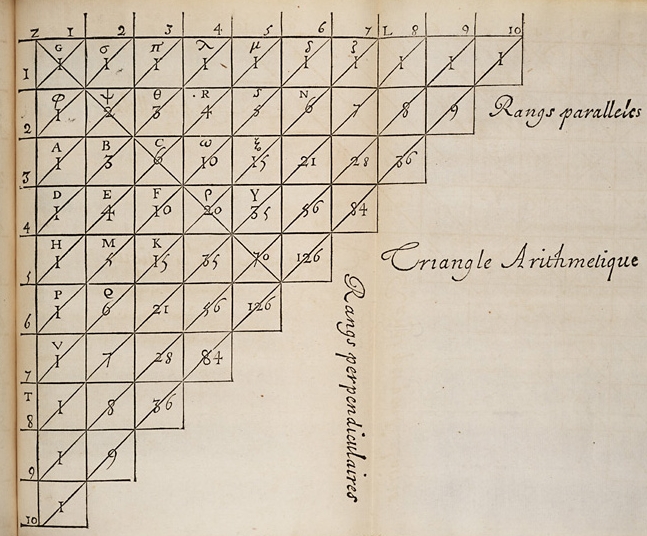
Pascal’s Triangle is a triangular array of binomial coefficients determined by binomial expansion. What is all of this crazy math talk?! Well, binomials are used in algebra and look like 4x+10 or 5x+2.
Start with 1 at the top. Each new row begins and ends with 1; every interior entry is the sum of the two entries directly above it. These numbers are binomial coefficients, which also count combinations. They become probabilities only when used in a specific probability model.
Patterns, Patterns, Patterns!
There are so many neat patterns in Pascal’s Triangle. The first diagonal of the triangle just contains “1”s while the next diagonal has numbers in numerical order. The third diagonal has triangular numbers and the fourth has tetrahedral numbers.
The row sums are powers of two: 1, 2, 4, 8, 16, and so on. The first five rows also read as powers of 11 when you join their entries; after that, entries have more than one digit, so you must use place value and carry rather than simply join the numbers.
You might also like our Pascal’s Triangle Christmas Tree Patterns math activity.
Pascal’s Triangle is also symmetrical! If you were to fold the triangle in half, the numbers on the right side are identical to the numbers on the left side.
The pattern that I think is super cool is the Sierpinski Triangle, which can be found if you color all of the odd numbers in Pascal’s Triangle.
12 Days of Christmas
Count the Repeated Gifts, Not Just the Last Verse
The carol is cumulative: each new day brings its new gift plus all the gifts from earlier verses again. For this activity, we count each bird, ring, and person as one gift, and treat a partridge in its pear tree as one named gift rather than counting the tree separately.
On day two, that means two doves and another partridge. On day three, it means three hens, two more doves, and another partridge: six gifts that day and ten received so far.
Read or sing a few verses together, then pause to record two different quantities: the gifts arriving that day and the running total across all days. Keeping those columns separate is the key to the whole investigation.
How many gifts were sent in the 12 Days of Christmas?
Let’s break it down using Pascal’s triangle.

On the First Day of Christmas – A Partridge in a Pear Tree

On the first (purple triangle) day of Christmas, 1 partridge in a pear tree was given (red triangle) for a combined total of 1 gift given overall (blue triangle).

On the Second Day of Christmas – Two Turtle Doves

On the second (purple triangle) day of Christmas, 1 partridge in a pear tree and 2 turtle doves are given for a total of 3 gifts given that day (red triangle). The combined total of gifts given is 4 (blue triangle).

On the Third Day of Christmas – Three French Hens

On the third (purple triangle) day of Christmas, 1 partridge in a pear tree, 2 turtle doves, and 3 French hens are given for a total of 6 gifts given that day (red triangle). The combined total of gifts given is 10 (blue triangle).

On the Fourth Day of Christmas – Four Calling Birds

On the fourth (purple triangle) day of Christmas, 1 partridge in a pear tree, 2 turtle doves, 3 French hens, and 4 calling birds are given for a total of 10 gifts given that day (red triangle). The combined total of gifts given is 20 (blue triangle).

On the Fifth Day of Christmas – Five Golden Rings

On the fifth (purple triangle) day of Christmas, 1 partridge in a pear tree, 2 turtle doves, 3 French hens, 4 calling birds, and 5 golden rings are given for a total of 15 gifts given that day (red triangle). The combined total of gifts given is 35 (blue triangle).

On the Sixth Day of Christmas – Six Geese Laying

On the sixth (purple triangle) day of Christmas, 1 partridge in a pear tree, 2 turtle doves, 3 French hens, 4 calling birds, 5 golden rings, and 6 geese a-laying are given for a total of 21 gifts given that day (red triangle). The combined total of gifts given is 56 (blue triangle).

On the Seventh Day of Christmas – Seven Swans Swimming

On the seventh (purple triangle) day of Christmas, 1 partridge in a pear tree, 2 turtle doves, 3 French hens, 4 calling birds, 5 golden rings, 6 geese a-laying, and 7 swans a-swimming are given for a total of 28 gifts given that day (red triangle). The combined total of gifts given is 84 (blue triangle).

On the Eighth Day of Christmas – Eight Maids Milking

On the eighth (purple triangle) day of Christmas, 1 partridge in a pear tree, 2 turtle doves, 3 French hens, 4 calling birds, 5 golden rings, 6 geese a-laying, 7 swans a-swimming, and 8 maids a-milking are given for a total of 36 gifts given that day (red triangle). The combined total of gifts given is 120 (blue triangle).

On the Ninth Day of Christmas – Nine Ladies Dancing

On the ninth (purple triangle) day of Christmas, 1 partridge in a pear tree, 2 turtle doves, 3 French hens, 4 calling birds, 5 golden rings, 6 geese a-laying, 7 swans a-swimming, 8 maids-a-milking, and 9 ladies dancing are given for a total of 45 gifts given that day (red triangle). The combined total of gifts given is 165 (blue triangle).

On the Tenth Day of Christmas – Ten Lords Leaping

On the tenth (purple triangle) day of Christmas, 1 partridge in a pear tree, 2 turtle doves, 3 French hens, 4 calling birds, 5 golden rings, 6 geese a-laying, 7 swans a-swimming, 8 maids-a-milking, 9 ladies dancing, and 10 lords a-leaping are given for a total of 55 gifts given that day (red triangle). The combined total of gifts given is 220 (blue triangle).

On the Eleventh Day of Christmas – Eleven Pipers Piping

On the eleventh (purple triangle) day of Christmas, 1 partridge in a pear tree, 2 turtle doves, 3 French hens, 4 calling birds, 5 golden rings, 6 geese a-laying, 7 swans a-swimming, 8 maids-a-milking, 9 ladies dancing, 10 lords a-leaping, and 11 pipers piping are given for a total of 66 gifts given that day (red triangle). The combined total of gifts given is 286 (blue triangle).

On the Twelfth Day of Christmas – Twelve Drummers Drumming

On the twelfth (purple triangle) day of Christmas, 1 partridge in a pear tree, 2 turtle doves, 3 French hens, 4 calling birds, 5 golden rings, 6 geese a-laying, 7 swans a-swimming, 8 maids-a-milking, 9 ladies dancing, 10 lords a-leaping, 11 pipers piping, and 12 drummers drumming are given for a total of 78 gifts given that day (red triangle). The combined total of gifts given is 364 (blue triangle).

Wowza! That’s a lot of gifts!

The Diagonals of Pascal’s Triangle
The second diagonal in Pascal’s triangle (purple triangles) is in numerical order and relates to the 12 Days of Christmas carol by showing us both the day and the amount of the new gift given that day.
The third diagonal is made of triangular numbers (red triangles) and shows us the total number of gifts given on each day.
The fourth diagonal (blue triangles) is made of tetrahedral numbers and shows the combined total of gifts given so far during the 12 Days of Christmas.
A tetrahedron has four triangular faces: a triangular base and three other faces. A tetrahedral number counts objects arranged in stacked triangular layers; 364 counts twelve layers containing 1, 3, 6, 10, 15, 21, 28, 36, 45, 55, 66, and 78 objects.
You can check the answer another way by counting each gift type across all the days on which it appears:
- 12 partridges in pear trees (12 days x 1 given each day)
- 22 turtle doves (11 days x 2 given each day)
- 30 French hens (10 days x 3 given each day)
- 36 calling birds (9 days x 4 given each day)
- 40 golden rings (8 days x 5 given each day)
- 42 geese a-laying (7 days x 6 given each day)
- 42 swans a-swimming (6 days x 7 given each day)
- 40 maids milking (5 days x 8 given each day)
- 36 ladies dancing (4 days x 9 given each day)
- 30 lords a-leaping (3 days x 10 given each day)
- 22 pipers piping (2 days x 11 given each day)
- 12 drummers drumming (1-day x 12 given that day)
For a grand total of 364 total gifts. It’s probably a good thing there are only 12 drummers with the amount of noise they probably make!
Fill in your own Pascal’s Triangle Christmas Tree and download some free worksheets!
12 Days of Christmas Pascal’s Triangle Challenge
Challenge: Can you use the triangular numbers diagonal to build a “12 days of Christmas” tetrahedron with 364 pom-pom balls?
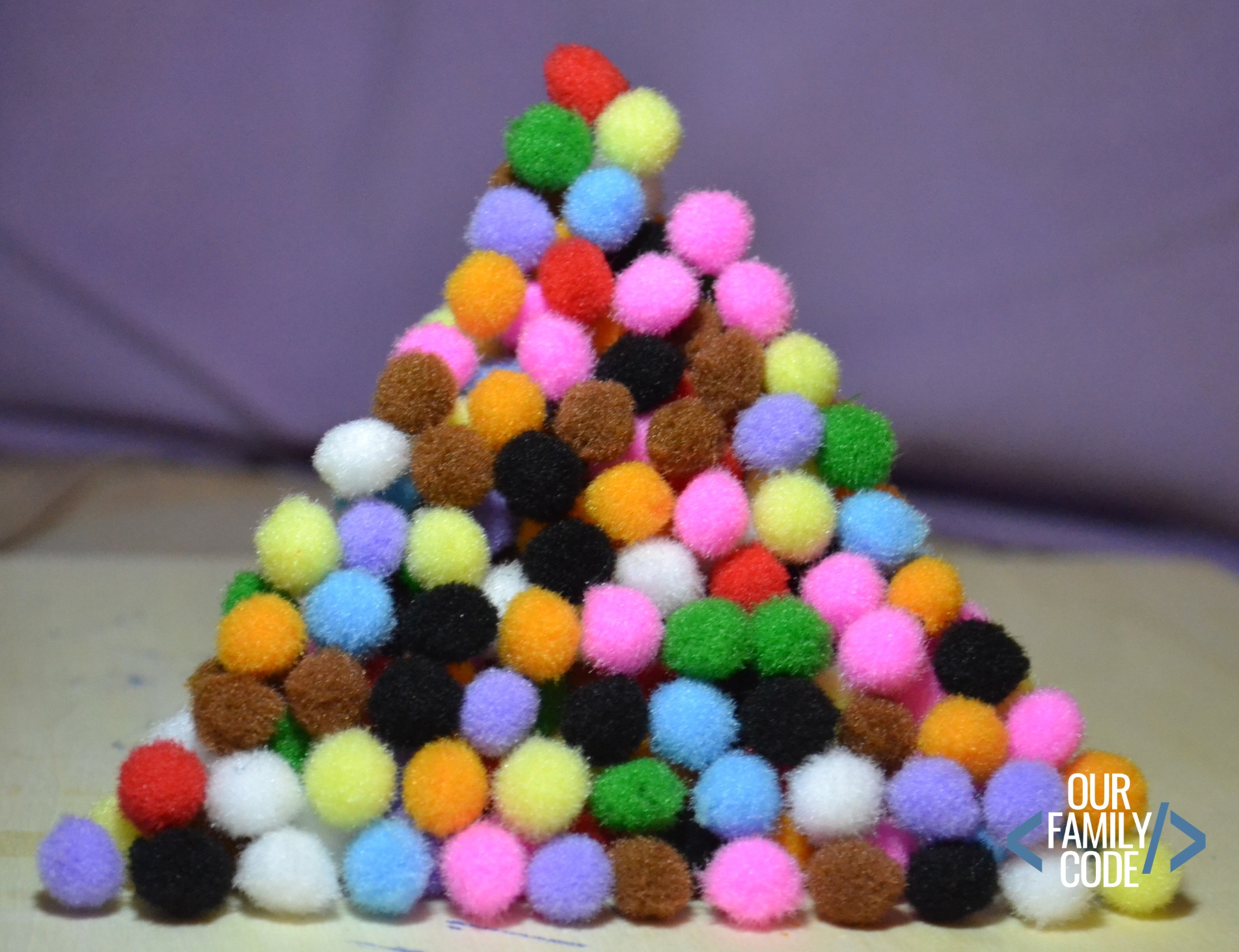
We used 1/2-inch pom-pom balls and followed the third diagonal of triangular numbers to build our “12 Days of Christmas” tetrahedron.
It was a pretty challenging feat since the pom pom balls wanted to roll, but if you go slowly and make sure to count the right amount per level, you’ll end with a 364 pom-pom ball tetrahedron that represents the total amount of gifts given during the 12 days of Christmas carol!
PIN THIS IMAGE TO SAVE THIS 12 DAYS OF CHRISTMAS PASCAL’S TRIANGLE MATH ACTIVITY!

Build the Tetrahedron One Layer at a Time
Begin with a flat triangular base of 78 pom-poms arranged in twelve rows. The next layer uses 66 in eleven rows, followed by layers of 55, 45, 36, 28, 21, 15, 10, 6, 3, and finally 1 at the top.
Build each layer separately on paper first and label its count before stacking. A tray helps contain rolling pieces; if the full model is too fiddly, keep the twelve labeled triangles flat and use their counts to demonstrate the same total.
Our original pom-poms wanted to roll, so this is a useful place to slow down and treat stability as part of the challenge. Start with three or four layers if you want a smaller model before attempting all 364 pieces.
Questions, Checks, and Extensions
Ask children whether 78 or 364 answers the question “How many gifts arrive on the twelfth day?” Then ask which number answers “How many gifts have arrived by the end?” and have them justify both answers using their chart.
A common mistake is to add 1 through 12 once and stop at 78. That counts the last day’s complete delivery; it does not include the deliveries from the earlier eleven days.
Another useful check counts each gift type separately. One partridge arrives on twelve days, while twelve drummers arrive on only one day; both categories contribute twelve gifts overall.
Invite older children to explain the matching totals near opposite ends of the gift list. A group first introduced on day k appears on 13 − k days, so its contribution is k × (13 − k).
Extend the imaginary song to a thirteenth day and predict the next daily delivery and running total. Children can check that the new daily delivery would be 91 gifts and the combined total would become 455, then locate those numbers in the appropriate diagonals.
For a coding connection, write instructions that update two variables each day: add the day number to giftsToday, then add giftsToday to giftsSoFar. Both variables begin at zero, and the order of those two instructions matters.
You Might Also Like
Continue with Pascal’s Triangle Christmas Tree Patterns to explore the triangle with printable activities. Try Christmas coordinate graphing for another math investigation, or browse Christmas STEAM activities for more seasonal projects.
Meet Toni, the Maker Mom behind Our Family Code

Hey there, I’m Toni! I’m a software engineer and Maker Mom that finds my joy in unleashing my children’s curiosity by exploring STEAM concepts with my fantastic five!
When I’m not chasing toddlers or raising tweens, you can find me tearing things up and putting them back together over here at Our Family Code.
I am the owner and content creator of multiple educational websites designed to increase access to STEAM & STEM education with a focus on teaching computer science and coding to kids of all ages!